
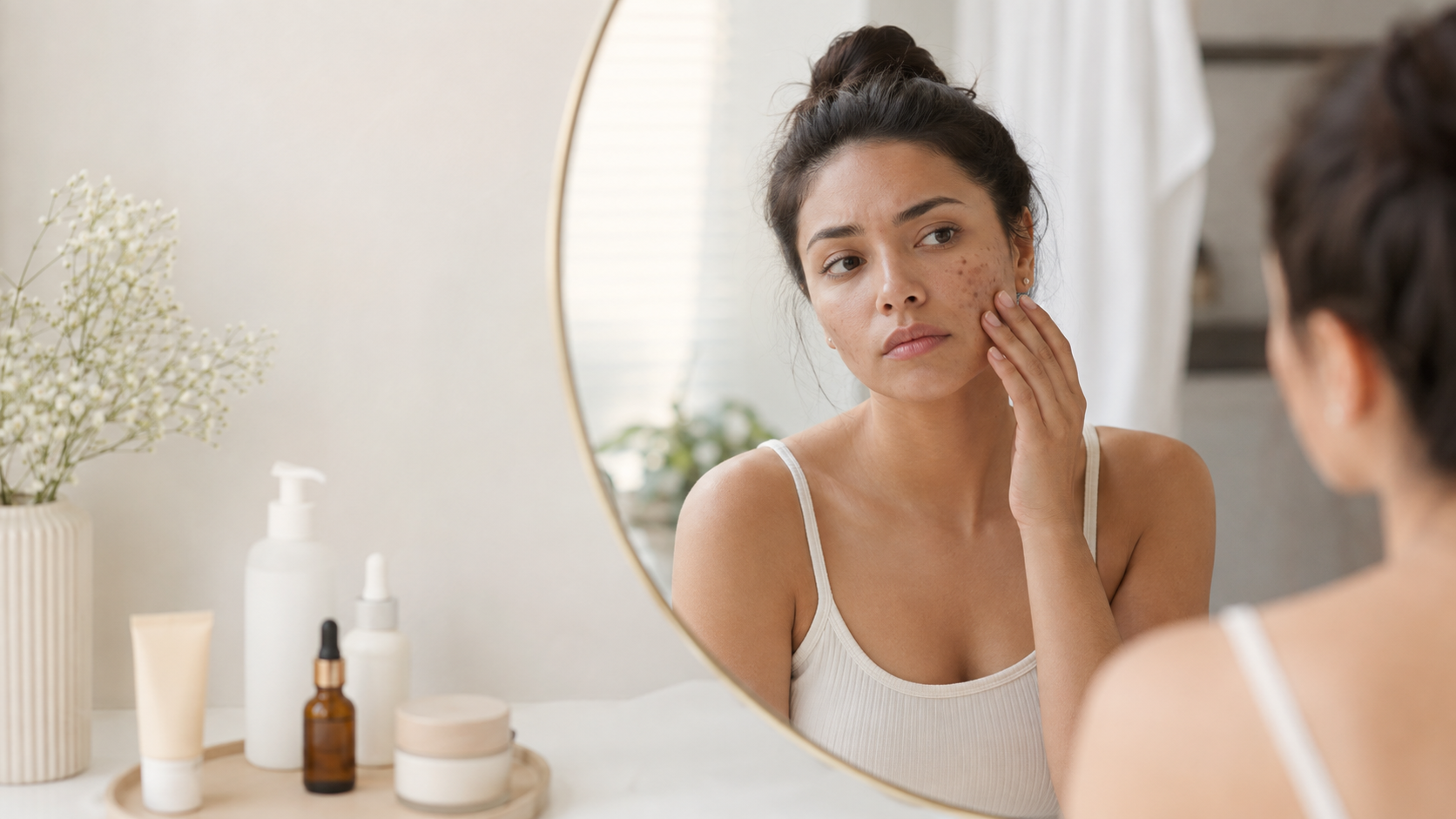
The pimple is gone.
The swelling is gone.
The pain is gone.
But somehow the dark mark is still sitting there like it signed a lease.
If your breakouts keep leaving behind spots that last for weeks or months, you’re probably not dealing with an “active pimple” anymore. You’re dealing with the aftermath.
Those lingering marks are often a form of post-inflammatory hyperpigmentation, or PIH. That means the breakout caused inflammation, your skin responded by producing extra pigment, and now the blemish is gone but the color change remains.
The frustrating part is that you can end up with a face full of marks even when you don’t have much active acne anymore.
The good news is that the routine for preventing new breakouts and the routine for fading old marks can work together.
Why Do Pimples Leave Dark Spots After They Heal?
When a pimple becomes inflamed, your skin can respond by producing extra melanin in that area.
Once the breakout heals, that extra pigment may remain behind.
That’s why you can have:
- no swelling
- no active pimple
- no pain
and still see a brown, gray-brown, reddish-brown or darker mark where the breakout used to be.
The darker mark isn’t necessarily a scar.
It may simply be pigment left behind after inflammation.
And if you tend to get new breakouts before the old marks fade, it can feel like your skin never completely clears.
Why Are My Acne Dark Spots Taking Months to Fade?
Because pigment can be stubborn.
The breakout itself may heal relatively quickly, but the discoloration can take much longer to fade.
And there’s another problem.
You may be creating new marks faster than the old ones are disappearing.
Think about the cycle:
breakout → inflammation → dark mark → new breakout → another dark mark
You might fade three marks and develop four new ones.
That can make it seem like your dark-spot routine is doing absolutely nothing.
This is why treating acne and discoloration at the same time usually makes more sense than focusing only on the marks.
Does Picking Pimples Make Dark Spots Worse?
Yes.
And unfortunately, this is one of the hardest habits to stop.
You see the whitehead.
You tell yourself you’ll just “gently” squeeze it.
Five minutes later you’re two inches from the mirror performing a procedure nobody authorized.
Picking can create more inflammation and trauma in the skin.
That means the pimple that might have healed quietly can turn into a longer-lasting mark.
If you’re especially prone to post-breakout discoloration, squeezing, scratching and picking can work against you.
Hydrocolloid pimple patches can be useful here because they create a physical barrier between your fingers and the blemish.
A popular option is Hero Cosmetics Mighty Patch Original.
These are especially convenient for whiteheads because they can help protect the area while making it much harder for you to pick at it.
Sometimes the best dark-spot prevention tool is simply something that keeps your hands off your face.
Why Am I Getting New Dark Spots Even Though I Use a Brightening Serum?
Because a brightening serum can’t stop a new pimple from becoming inflamed.
If you’re treating the pigmentation but ignoring the acne that keeps creating it, you’re stuck in the same cycle.
This is why your routine needs two jobs:
Job #1: Reduce new breakouts.
Job #2: Gradually improve the marks already there.
That doesn’t mean you need ten active ingredients.
In fact, too many actives can create irritation, which is exactly what you’re trying to avoid.
A simple routine is usually much easier to stick with.
Can Salicylic Acid Help With Acne and Dark Spots?
Salicylic acid is a beta hydroxy acid commonly used for acne-prone skin because it helps exfoliate inside and around the pore.
That makes it useful when clogged pores and breakouts are part of the problem.
One easy product option is CeraVe Acne Control Cleanser with 2% Salicylic Acid.
It can fit into a routine where the primary goal is reducing breakouts without adding another leave-on serum.
If your skin is sensitive, don’t assume stronger or more frequent use will work faster.
Start according to the product directions and pay attention to dryness or irritation.
Does Azelaic Acid Help With Acne Dark Spots?
Azelaic acid is one of the more useful ingredients for this exact situation because it can make sense for someone concerned about both breakouts and uneven tone.
A straightforward option is The Ordinary Azelaic Acid Suspension 10%.
It can fit into a nighttime routine after cleansing and before moisturizer.
The key is not to combine it with every other active ingredient you own on day one.
If you’re already using salicylic acid, retinoids or exfoliating acids, introduce new products gradually.
Your skin does not need a group project.
Why Is Sunscreen Important for Acne Dark Spots?
Because sun exposure can make existing pigmentation look darker and more noticeable.
This is the step people love to skip because sunscreen doesn’t feel like a dark-spot treatment.
But if you’re trying to improve uneven tone, protecting your skin from UV exposure matters.
Look for a broad-spectrum SPF 30 or higher that you’ll actually wear every day.
One popular option is EltaMD UV Clear Broad-Spectrum SPF 46.
It’s designed with acne-prone and sensitive skin in mind and fits easily into a morning routine.
The best sunscreen is the one you’ll actually use consistently.
A perfect formula sitting untouched in a drawer does nothing for you.
Can Over-Exfoliating Make Acne Marks Last Longer?
It can make your skin more irritated, which is exactly what you don’t want.
This happens all the time.
You notice dark spots.
You add glycolic acid.
Then salicylic acid.
Then retinol.
Then vitamin C.
Then a scrub.
Then you wonder why your face burns when water touches it.
More actives do not automatically equal faster fading.
If your skin is:
- peeling
- stinging
- very dry
- red
- tight
- unusually sensitive
your routine may be doing too much.
A damaged, irritated routine is not a good foundation for treating pigmentation.
What Is the Best Routine for Acne and Dark Spots at the Same Time?
Keep it simple enough to follow.
Morning
1. Gentle cleanser
Use something that cleans without leaving your face feeling stripped.
2. Optional niacinamide serum
Niacinamide can be useful for uneven-looking tone and supporting the skin barrier.
3. Moisturizer
Choose one that works for your skin type.
4. Broad-spectrum SPF 30 or higher
A product such as EltaMD UV Clear Broad-Spectrum SPF 46 fits well here.
That’s your morning.
Night
1. Cleanse
If breakouts are still a problem, use a cleanser such as CeraVe Acne Control Cleanser with 2% Salicylic Acid as tolerated.
2. Apply azelaic acid
Use The Ordinary Azelaic Acid Suspension 10% if it works well for your skin.
3. Moisturize
Do not skip moisturizer because your skin is oily.
Acne-prone skin can still become dry and irritated.
For Active Whiteheads
Apply a Hero Cosmetics Mighty Patch Original instead of picking.
Then leave it alone.
That alone can save you from turning one temporary pimple into a mark that lasts for months.
What Should I Stop Doing If Every Pimple Leaves a Dark Spot?
Stop picking.
Stop squeezing.
Stop checking the pimple every twenty minutes.
Stop scrubbing dark marks like they can be physically removed.
Stop switching products every week.
Stop introducing five new active ingredients at once.
Stop skipping sunscreen.
And stop assuming the strongest product is automatically the best product.
Your skin needs consistency more than chaos.
How Long Does It Take for Acne Dark Spots to Fade?
This is the part nobody loves.
It can take time.
Some marks gradually become less noticeable over several weeks.
Others may take months.
The exact timeline depends on the depth of the pigmentation, your skin tone, how much inflammation occurred and whether you’re still developing new breakouts.
That’s why judging your progress every morning is frustrating.
Take photos every few weeks in similar lighting instead.
You may notice that:
- fewer new marks are appearing
- older spots are fading
- breakouts are becoming less frequent
- the overall tone looks more even
before every single spot disappears.
That still counts as progress.
Are Acne Dark Spots the Same Thing as Acne Scars?
Not necessarily.
This is an important distinction.
A flat mark that is darker than the surrounding skin may be post-inflammatory hyperpigmentation.
A true acne scar involves a change in the skin’s texture, such as:
- a depression
- indentation
- raised scar
- uneven surface
Pigment-focused skincare can help with discoloration, but it won’t necessarily correct deeper textural scars.
If you’re dealing with indentations or raised scars, professional treatments may be more appropriate.
Why Does the Same Area Keep Breaking Out and Leaving New Marks?
Sometimes the biggest clue is the location.
If the same area repeatedly breaks out, look at what touches it.
Your phone.
Pillowcase.
Hair products.
Makeup.
Hands.
Masks.
Sweat.
Friction.
If breakouts constantly appear along the jawline or hairline, your skincare routine may not be the only thing involved.
Paying attention to patterns can help you reduce the number of new spots you’re creating.
What Ingredients Should I Look for in Products for Acne Dark Spots?
You don’t need every brightening ingredient on the shelf.
A few commonly used options include:
Azelaic acid for uneven tone and blemish-prone skin.
Niacinamide for supporting the skin barrier and improving the appearance of uneven tone.
Vitamin C for brightening and antioxidant support.
Retinoids for acne and skin-cell turnover.
Salicylic acid for clogged pores and breakouts.
The best combination depends on what your skin tolerates.
If you’re prone to irritation, start with fewer products.
You can always add more later.
Frequently Asked Questions About Acne Dark Spots
Why is the pimple gone but the dark spot is still there?
The breakout healed, but inflammation from the pimple may have triggered extra pigment production. That pigment can remain after the active acne is gone.
Do acne dark spots fade on their own?
Many post-inflammatory marks gradually fade over time, but the process can take weeks or months.
Can sunscreen really help acne marks?
Sunscreen helps protect the skin from UV exposure that can make pigmentation look darker and more noticeable. It’s an important part of any routine targeting uneven tone.
Should I use salicylic acid or azelaic acid for acne dark spots?
Salicylic acid is especially useful when clogged pores and active breakouts are the bigger issue. Azelaic acid can make sense when you’re also targeting post-breakout discoloration. Some people use both in the same overall routine, but introducing them gradually can help minimize irritation.
Can I use vitamin C on acne dark spots?
Vitamin C is commonly used in routines targeting uneven tone and brightness. If you already use multiple active ingredients, introduce it carefully rather than adding everything at once.
Do pimple patches prevent dark spots?
They don’t directly erase pigmentation, but they can help protect a blemish and make it harder to pick. Less picking can mean less additional trauma to the skin.
Why do I keep getting dark marks even though my acne is mild?
Even small inflamed breakouts can leave pigmentation behind, especially if you’re prone to post-inflammatory hyperpigmentation.
What if my dark spots are not fading at all?
If discoloration is persistent, worsening, changing in appearance or you’re not sure whether you’re dealing with pigmentation or scarring, a dermatologist can help determine what’s going on.
The Bottom Line
If the pimple disappeared weeks ago but the dark mark is still staring back at you, don’t panic and don’t attack it.
The best strategy is to break the cycle.
Reduce new breakouts with something like CeraVe Acne Control Cleanser with 2% Salicylic Acid.
Protect active whiteheads from your fingers with Hero Cosmetics Mighty Patch Original.
Use a targeted ingredient such as The Ordinary Azelaic Acid Suspension 10% for uneven tone.
And wear a broad-spectrum sunscreen such as EltaMD UV Clear Broad-Spectrum SPF 46 every morning.
You’re not just trying to fade yesterday’s mark.
You’re trying to stop tomorrow’s pimple from leaving another one.


