
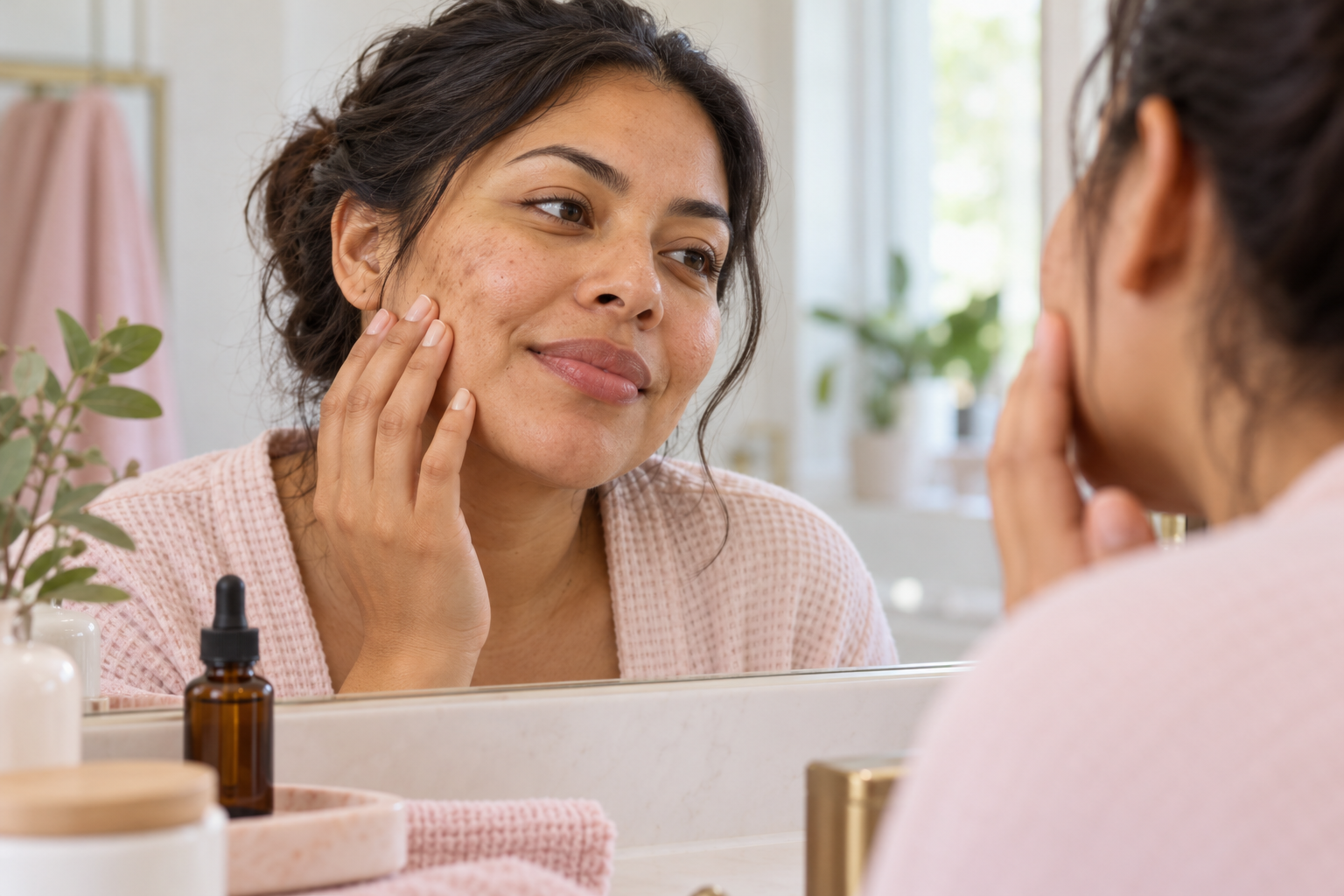
A pimple can disappear long before the dark mark it leaves behind. Add another breakout or an irritating skincare experiment, and it can feel as though your complexion never catches up.
A thoughtful dark-spot routine does more than target the marks already there. It considers why new ones keep appearing, whether your products are comfortable, and how sun protection fits into your day. Buying several brightening ingredients at once can make that process harder to evaluate.
As an Amazon Associate I earn from qualifying purchases. If you shop through affiliate links in this post, iGlamorBar may earn a commission at no additional cost to you.
First, understand what kind of discoloration you’re seeing
A flat brown mark after acne may be post-inflammatory hyperpigmentation, often shortened to PIH. Inflammation can trigger additional pigment, particularly in people with medium to deep skin tones.
That isn’t the same as an indented acne scar. And a broad, symmetrical patch isn’t automatically an acne mark. Melasma, irritation, and other conditions can create discoloration that needs a different approach.
Treat a new, changing, bleeding, or otherwise unusual spot as something to have evaluated, not as an invitation to apply a stronger brightening product. Identifying the problem is more valuable than collecting ingredients for a problem you may not have.
Why new marks can keep appearing while older ones fade
If acne is still active, treating discoloration alone leaves the source of new marks untouched. Picking adds another form of injury. An irritating routine can also create inflammation in skin that’s prone to darkening after irritation.
Separate your goals: fewer new blemishes, fewer fresh dark marks, and gradual change in existing discoloration. These don’t necessarily move at the same speed. Tracking them separately can make progress easier to recognize.
This is also why visible peeling isn’t proof that a dark-spot routine is working. The aim is an effective, tolerable plan, not maximum exfoliation.
Vitamin C: an optional antioxidant and brightening step
Vitamin C is used in cosmetic formulas for antioxidant support and the appearance of uneven tone. The form of vitamin C, concentration, packaging, and finished formulation influence how a product behaves.
Pure L-ascorbic acid products can be irritating for some people, and a higher percentage isn’t automatically the best starting point. A serum also doesn’t replace sunscreen or establish the cause of a patch of pigment.
Product to consider: Timeless Skin Care 10% Vitamin C + E Ferulic Acid Serum
Timeless Skin Care 10% Vitamin C + E Ferulic Acid Serum combines 10% L-ascorbic acid with vitamin E and ferulic acid. It is a candidate for someone who wants a defined vitamin C step for dullness and uneven-looking tone and would prefer to consider the 10% version before a higher-concentration option.
The practical drawback is product care: follow the brand’s storage instructions and opening-life guidance, including its recommendation about refrigeration. Don’t buy an oversized supply if you won’t use it appropriately. Sensitive skin can still react, even when a lower percentage seems appealing.
Azelaic acid: a different option for uneven-looking tone
Azelaic acid is used in both cosmetic products and medical treatments, depending on formulation and jurisdiction. It can be relevant when discoloration and blemish concerns overlap, but a cosmetic product should not be presented as equivalent to a prescription treatment.
You don’t need to begin vitamin C and azelaic acid together. Choosing one optional active makes it easier to assess comfort and determine whether it fits your priorities.
Product to consider: The Ordinary Azelaic Acid Suspension 10%
The Ordinary Azelaic Acid Suspension 10% is a cream-like cosmetic option marketed for uneven-looking tone and texture. It may suit someone who prefers a suspension rather than a watery serum and wants to explore azelaic acid as their single new active.
Its texture is a meaningful consideration. Check how it layers with your moisturizer and makeup, and follow the manufacturer’s order-of-application and compatibility guidance. It isn’t a substitute for a dermatologist’s plan for persistent acne or melasma.
Why tinted sunscreen deserves its own place
A pigmentation routine needs protection as well as treatment. Broad-spectrum sunscreen addresses UVA and UVB exposure. For people prone to hyperpigmentation, tinted formulas containing iron oxides can also help with visible-light protection.
The tint has a practical job too: shade compatibility influences whether you’ll apply the product generously enough. A product that looks wrong on your skin may encourage you to use too little, undermining its purpose.
Product to consider: CeraVe Hydrating Mineral Sunscreen SPF 30 Face Sheer Tint
CeraVe Hydrating Mineral Sunscreen SPF 30 Face Sheer Tint is a mineral option with zinc oxide and titanium dioxide, plus a tinted finish. The line has Light, Medium, and Deep variants, so choose the shade rather than assuming one tint suits everyone.
This may appeal to someone who wants daily facial protection with some tone blending. It isn’t full-coverage makeup, and a shade range doesn’t guarantee a perfect match for every undertone. Check the specific package for water-resistance instructions before choosing it for swimming or heavy sweating.
Build a plan around one new active
In the morning, cleanse as needed, use your chosen optional serum if its instructions fit, moisturize when needed, and apply sunscreen as directed. During outdoor exposure, follow reapplication instructions and use shade and clothing too.
In the evening, remove the day’s products and follow your established care plan. If azelaic acid is the new product you choose, fit it into the routine according to its label rather than layering it with every brightening item you own.
If acne is ongoing, make a treatment plan for it. If products sting or cause a rash, resolve the irritation before adding another brightener. Your routine should be simple enough that you can tell which step does what.
Set realistic expectations
Dark marks often take months to change, and some persist much longer. Their depth, cause, continued triggers, and treatment all matter. An article can’t promise that one cosmetic serum will remove every kind of pigmentation on a fixed deadline.
If you take progress photos, use similar lighting and camera settings. Compare changes over time rather than inspecting your face under different bathroom lights every day.
Frequently asked questions
Should I buy all three products?
No. Sunscreen and a brightening active have different roles, but vitamin C and azelaic acid are optional alternatives to consider. You don’t have to start both.
Can I use facial dark-spot products on intimate skin?
Don’t transfer a facial routine to genital or mucosal skin. The area, cause, and tolerances differ, and persistent discoloration deserves appropriate assessment.
What if a dark mark is becoming raised or changing?
Have it evaluated. Changes in a spot shouldn’t be managed by repeatedly applying cosmetic brighteners.
Which part of your routine would be most useful to improve first: treating new breakouts, finding a comfortable sunscreen, or choosing one optional active?
Related reading: Why Your Dark Spots Aren’t Fading Even Though You’re Using Brightening Products.


