
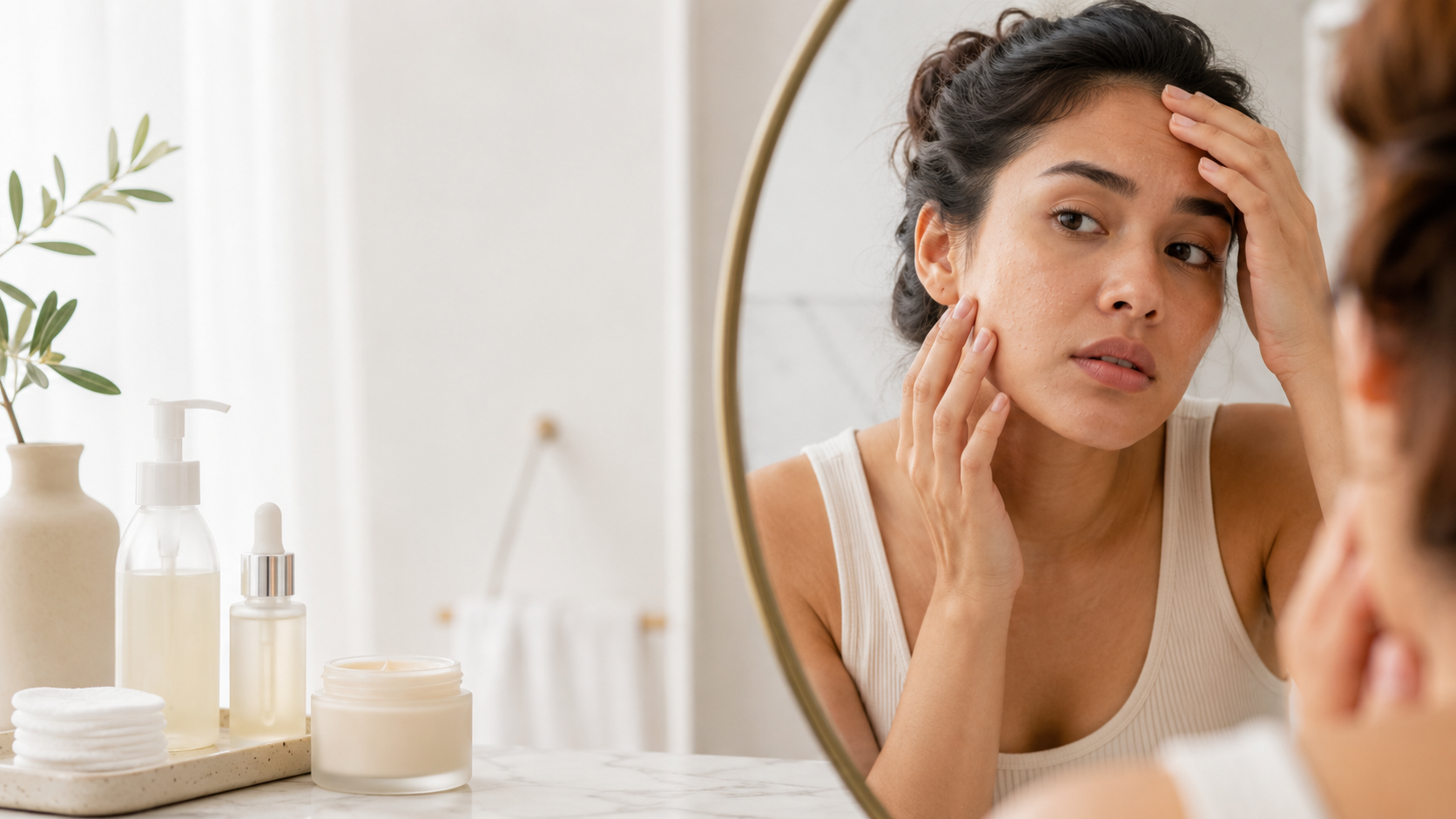
Your skin looks clear from across the room.
Then you get close to the mirror.
Tiny bumps.
Little rough patches.
Texture that makeup somehow finds and highlights with the enthusiasm of a spotlight operator.
And the weirdest part?
You don’t even really have acne.
If your skin feels bumpy, uneven or clogged even though you’re not dealing with obvious breakouts, the problem may be a mix of dead skin buildup, clogged pores, irritation and products that are simply too heavy for your skin.
The goal isn’t to scrub your face into submission.
It’s to help keep pores clear while keeping your skin barrier calm.
Why Does My Skin Feel Bumpy Even Though I Don’t Have Acne?
Not every bump is a pimple.
Some tiny bumps can come from clogged pores, dead skin buildup or uneven texture.
When oil and dead skin collect around the opening of a pore, you may notice little flesh-colored bumps that don’t look red or inflamed.
They might feel more obvious than they look.
You may especially notice them on the:
- forehead
- cheeks
- chin
- sides of the nose
- jawline
This is where people often make the mistake of treating every bump like aggressive acne.
But if there’s no redness, swelling or tenderness, your skin may need gentle pore-clearing rather than an all-out acne attack.
What Causes Tiny Flesh-Colored Bumps on the Face?
Several things can contribute.
Dead skin buildup
Your skin naturally sheds dead cells, but sometimes they don’t leave the surface as efficiently as you’d like.
That buildup can make the skin feel rough and uneven.
Clogged pores
Oil, sunscreen, makeup and dead skin can collect around pores and create small bumps.
Heavy skincare products
A rich cream that works beautifully for someone with very dry skin may feel too heavy on skin that clogs easily.
Hair products touching the face
Pomades, oils, conditioners and styling products can end up on your forehead, temples and hairline.
If the bumps are mostly around your hairline, pay attention to what’s touching that area.
Over-exfoliation
Yes, too much exfoliation can also make skin feel rough.
Irritated skin can become dry, flaky and uneven.
So the answer to bumpy skin is not automatically:
more acid.
Are Tiny Bumps on My Face Clogged Pores or Acne?
Sometimes they can be clogged pores without looking like classic acne.
Closed comedones are small clogged pores that often look like tiny flesh-colored bumps.
Unlike an inflamed pimple, they may not be:
- red
- painful
- swollen
They just sit there.
Quietly.
Annoyingly.
And somehow they become extremely visible the second you apply foundation.
If the bumps are persistent, itchy, spreading or look unusual, it’s worth having them evaluated because not every bump is caused by clogged pores.
Can Salicylic Acid Help With Tiny Bumps and Clogged Pores?
Salicylic acid is one of the most useful ingredients for this kind of problem.
It’s a beta hydroxy acid, or BHA, that can help exfoliate inside and around the pore.
That makes it useful when your skin feels congested or bumpy.
One popular option is Paula’s Choice Skin Perfecting 2% BHA Liquid Exfoliant.
It contains 2% salicylic acid and is designed for concerns like clogged pores, blackheads and uneven texture.
The important part is how you use it.
Start slowly.
You do not need to soak your face in it every night.
Use it according to the product directions and reduce frequency if your skin starts feeling dry, tight or irritated.
Your skin does not need to tingle to prove the product is working.
Why Is My Skin Still Bumpy Even Though I Exfoliate?
Because exfoliation may not be the only problem.
Sometimes people exfoliate faithfully while doing everything else possible to clog or irritate their skin.
For example:
You use a BHA.
Then apply a thick oil.
Then sleep with hair products rubbing against your forehead.
Then wear heavy foundation.
Then scrub your face because the bumps are still there.
That’s a lot.
If exfoliation isn’t helping, look at your entire routine.
Ask yourself:
Is my moisturizer too heavy?
Am I removing makeup thoroughly?
Do my hair products touch my face?
Am I using too many actives?
Does my skin feel calm or constantly irritated?
Sometimes simplifying the routine makes the biggest difference.
Can Over-Exfoliating Make Skin Texture Worse?
Yes.
This is one of the biggest mistakes people make with bumpy skin.
You feel roughness.
So you exfoliate.
Still rough?
Exfoliate again.
Then add a scrub.
Then retinol.
Then an exfoliating cleanser.
Then your skin suddenly feels tight, flaky and somehow even more textured.
That may not be congestion anymore.
That may be irritation.
If your skin starts:
- burning
- stinging
- peeling
- looking red
- feeling unusually tight
- becoming extra sensitive
back off.
Your skin barrier needs a chance to recover.
Smooth skin does not come from using the maximum possible number of exfoliating products.
What Is the Best Cleanser for Bumpy Skin and Clogged Pores?
A gentle cleanser is one of the most underrated parts of a texture routine.
You want to remove sunscreen, makeup, oil and buildup without leaving your skin feeling stripped.
A simple option is CeraVe Foaming Facial Cleanser.
It’s a straightforward cleanser that works well for many normal-to-oily skin types and can fit into a routine where your exfoliant is doing the heavy lifting.
You don’t necessarily need an acid cleanser, exfoliating toner and exfoliating serum all in the same routine.
One targeted exfoliant is often enough.
Can My Moisturizer Be Clogging My Pores?
Possibly.
That doesn’t mean moisturizer is bad.
It means the formula may not be ideal for your skin.
If you notice bumps becoming worse after starting a very rich balm, facial oil or heavy cream, pay attention.
A lightweight moisturizer may be a better fit.
One option is CeraVe PM Facial Moisturizing Lotion.
It’s lightweight and includes ceramides and niacinamide, making it useful when you want hydration without a very heavy finish.
Your skin can be oily and still need moisturizer.
Skipping moisturizer completely can leave your skin feeling irritated and tight, especially if you’re using salicylic acid.
Why Does My Forehead Have Tiny Bumps That Won’t Go Away?
Forehead bumps are especially common because that area gets exposed to so many products.
Think about what touches your forehead:
- shampoo
- conditioner
- hair oil
- edge control
- leave-in conditioner
- styling cream
- hats
- headbands
- sweat
If the bumps are mostly along the hairline, your hair routine may be contributing.
Try keeping heavier hair products away from the skin.
Wash your face after rinsing conditioner.
And clean anything that regularly touches your forehead.
Sometimes the problem isn’t what you’re putting on your face.
It’s what accidentally ends up there.
Why Does My Makeup Look Worse When My Skin Is Bumpy?
Because makeup loves texture.
Unfortunately.
Foundation can settle around rough patches and small bumps, making them appear more obvious than they do on bare skin.
This is why piling on more foundation usually doesn’t solve the problem.
The better approach is:
smooth the skin gradually,
keep it hydrated,
and avoid aggressive exfoliation right before applying makeup.
A simple moisturizer under makeup can often make texture look less obvious than trying to cover it with another layer of foundation.
Should I Use a Face Scrub for Tiny Bumps?
Usually, you don’t need a harsh scrub.
Physical scrubs can make the skin feel temporarily smooth, but aggressive rubbing may create irritation.
If clogged pores are the main issue, a BHA product like Paula’s Choice Skin Perfecting 2% BHA Liquid Exfoliant may be a more targeted option.
If you enjoy physical exfoliation, keep it extremely gentle and infrequent.
If your face looks red after scrubbing, that was not a successful exfoliation session.
That was an argument.
What Should I Stop Doing If My Skin Feels Bumpy?
Stop touching your face constantly.
Stop picking tiny bumps.
Stop switching products every three days.
Stop using several exfoliating acids at the same time.
Stop scrubbing until your skin feels squeaky.
Stop assuming oily skin doesn’t need moisturizer.
Stop sleeping in makeup.
Stop letting heavy hair products sit along your hairline.
And stop inspecting your skin under a magnifying mirror at midnight.
Nobody’s skin looks smooth at 10x magnification.
Nobody.
What Is a Simple Skincare Routine for Tiny Bumps and Clogged Pores?
Keep it boring enough to actually follow.
Morning
1. Gentle cleanser
Use CeraVe Foaming Facial Cleanser or another gentle cleanser that works for your skin.
2. Lightweight moisturizer
Apply CeraVe PM Facial Moisturizing Lotion or another lightweight moisturizer.
3. Broad-spectrum SPF 30 or higher
Sunscreen should be part of your everyday routine, especially when using exfoliating acids.
Night
1. Cleanse thoroughly
Remove makeup and sunscreen.
2. Use a BHA a few nights per week
Apply Paula’s Choice Skin Perfecting 2% BHA Liquid Exfoliant according to the product directions.
Start slowly.
You do not need to use it every night immediately.
3. Moisturize
Use a lightweight moisturizer.
That’s it.
No twelve-step pore detox.
No weekly facial boot camp.
Just consistency.
How Long Does It Take for Tiny Bumps and Clogged Pores to Improve?
Don’t expect your skin to completely change overnight.
Texture can gradually improve over several weeks with consistent care.
The first changes you may notice are:
- skin feeling smoother
- fewer new bumps
- less congestion
- makeup sitting better
- pores looking less clogged
Take photos every few weeks rather than checking your skin every morning.
You’ll notice changes much more easily that way.
Frequently Asked Questions About Tiny Bumps and Clogged Pores
Why do I have tiny bumps all over my face but no pimples?
Small bumps can come from clogged pores, dead skin buildup, irritation or other skin conditions. Not every bump is acne.
Does salicylic acid get rid of tiny bumps?
Salicylic acid can help exfoliate inside and around pores, making it useful when clogged pores are causing the bumps.
How often should I use BHA for clogged pores?
Start according to the product directions and your skin’s tolerance. Some people do well using it a few times per week before increasing frequency.
Can moisturizer cause tiny bumps?
A moisturizer that is too heavy for your skin may contribute to clogged pores. Try a lighter formula if you notice bumps appearing after introducing a new cream.
Should I squeeze closed comedones?
No. Picking and squeezing can create inflammation and potentially leave marks behind.
Why are my forehead bumps worse than the rest of my face?
Hair products, sweat, hats and styling products frequently come into contact with the forehead and hairline, which may contribute to congestion.
Can I use salicylic acid every day?
Some people tolerate daily use, while others become dry or irritated. Start slowly and increase only if your skin remains comfortable.
Why does my skin feel rough after exfoliating?
If your skin feels rough, tight, flaky or irritated after exfoliation, you may be overdoing it. Reduce the frequency and focus on gentle cleansing and moisturizing.
What if the tiny bumps are itchy?
Persistent itchy bumps may not simply be clogged pores. If the bumps itch, spread or don’t respond to a basic routine, a dermatologist can help determine what’s causing them.
The Bottom Line
If your skin feels bumpy even though you don’t have obvious acne, don’t immediately attack it with every exfoliating product you can find.
Start simple.
Cleanse gently with something like CeraVe Foaming Facial Cleanser.
Use Paula’s Choice Skin Perfecting 2% BHA Liquid Exfoliant a few times per week to help keep pores clear.
Follow with a lightweight moisturizer such as CeraVe PM Facial Moisturizing Lotion.
And then give your skin time.
The secret to smoother skin usually isn’t scrubbing harder.
It’s clearing buildup without creating a whole new irritation problem in the process.


